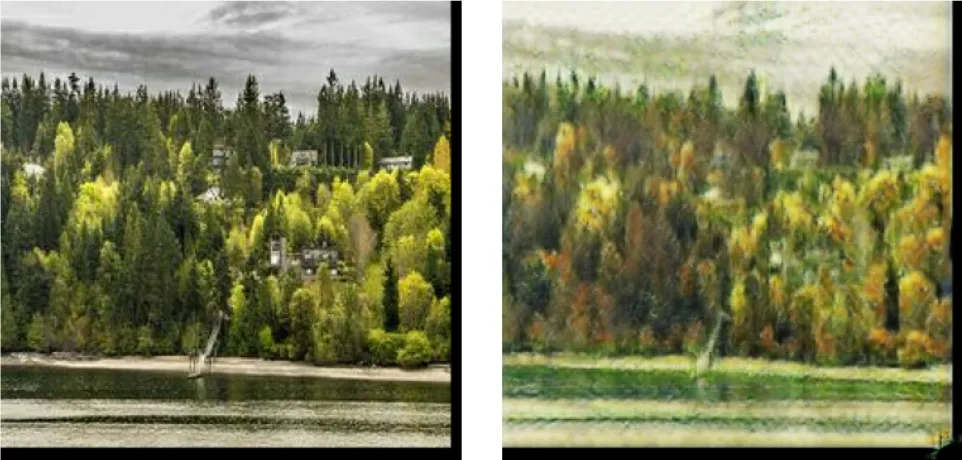
Monet art generator
Introduction & Objectives
This project investigates how deep learning can be applied to creative fields by training a CycleGAN (Generative Adversarial Network) framework. The goal is to translate everyday photographs into the unique painting style of Claude Monet rather than copying specific individual pieces. The model aims to capture high-level stylistic features such as unique color palettes, lighting transitions, textures, and expressive brushwork. CycleGAN is used because Impressionist paintings and real-world photos do not share direct pixel-to-pixel mapping, making it ideal for unpaired image-to-image translation tasks. To boost dataset diversity and prevent overfitting during training, data augmentation techniques like cropping, flipping, and color adjustments were incorporated.
Dataset & Setup
The project makes use of the “GAN Getting Started” dataset from Kaggle,
which provides separate folders for Monet paintings and photos in both .jpg
and .tfrec formats. The dataset includes 300 artistic paintings by Claude
Monet (monet_jpg / monet_tfrec) and 7,038 diverse real-world photographs
(photo_jpg / photo_tfrec). Following Kaggle source constraints, the
pipeline initializes securely via a Kaggle API token stored in Google Drive,
unzipping and staging data locally on a Google Colab GPU environment running
an NVIDIA T4 GPU.
Implementation Architecture
The codebase relies on TensorFlow alongside standard computer vision
libraries like OpenCV, Matplotlib, and NumPy for tensor management and
image preprocessing. The system is built around two primary competing sub-models
standard in GAN setups. The Generator takes input photos and synthesizes
brand-new, stylized images emulating Monet’s artistic methods. Meanwhile,
The Discriminator evaluates images to distinguish genuine Monet paintings
from generated forgeries, prompting the generator to improve continuously
through adversarial loss.
Evaluation Metric
MiFID (Memorization-informed Fréchet Inception Distance) is utilized to quantitatively evaluate the quality and stylistic accuracy of the generated images. A lower MiFID score denotes superior performance, proving that generated images accurately reflect the target art style without improperly memorizing or directly copying training images.